
USPS has issued many separately named Christmas and winter stamps, rather than one continuous numbered Christmas series. This guide compares three dated examples, then explains how to distinguish historical printed denominations from Forever postage and how to check a finished holiday mailing.
The Origin and Evolution of USPS Christmas Stamps
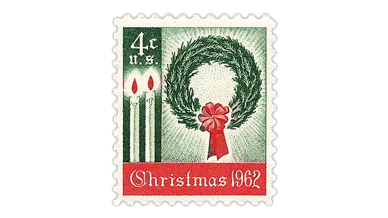
The U.S. Post Office Department issued the first U.S. Christmas stamp in 1962: a 4-cent wreath-and-candles design. Later postal programs added separate religious Christmas, secular winter, Hanukkah, Kwanzaa and other holiday issues. Identify each by its official name, date, denomination or service and original format rather than treating all of them as yearly installments of one technical series.
Selected historical Christmas stamps
These are illustrative issues, not a sales or popularity ranking. The USPS historical holiday-stamp list supplies the early dates, denominations and designers; the 2024 announcement identifies the modern issue.
| Issue | Release and postage type | How to recognize it and credited art |
|---|---|---|
| Christmas Wreath and Candles | November 1, 1962; 4¢ fixed denomination | Green-and-red wreath, two candles and “Christmas 1962” |
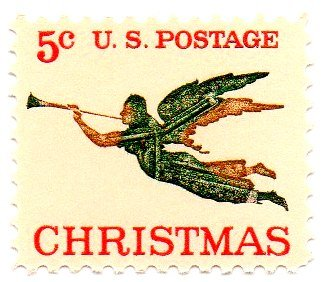
| Angel with Trumpet | November 2, 1965; 5¢ fixed denomination | Angel weather vane based on an 1840 example; watercolor by Lucille Gloria Chabot and stamp design by Robert Jones |
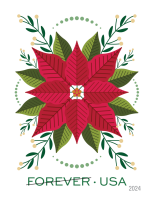
| Holiday Joy | 2024; ordinary domestic-letter Forever; booklet of 20 with four designs | Two ornaments, a poinsettia and a blue floral motif; digital illustrations by Michelle Muñoz, stamp and booklet design by Antonio Alcalá |
The first image below shows the 1962 wreath-and-candles issue. Its historical place does not by itself establish the collector value of a particular copy.
The next image lets a reader compare the 1965 angel weather vane with the earlier wreath-and-candles composition; the visual contrast is not a popularity ranking.
The poinsettia image shown here is one of the four Holiday Joy designs, not a separately named Poinsettia issue. The USPS announcement documents the complete booklet.
Key questions and answers: usage and purchase points
Do USPS stamps expire?
Where can I buy the latest Christmas stamps?
USPS post office counter: Ask for the exact Christmas issue and check current local stock before visiting. A historical Christmas design or a seasonal release date does not guarantee that a particular counter still has it for sale.
The Postal Store: Search the USPS online store for the exact current-season or earlier issue, then confirm whether it is listed and in stock at checkout. An earlier issue’s release record is not a live inventory statement.
Third-party retailers: Supermarkets, pharmacies and other independent sellers may carry USPS stamps, but their holiday designs and stock vary. Do not infer special USPS authorization from a store name or a discount; verify the seller, exact issue, condition and authenticity, especially for unusually cheap offers.
Decorative customization platforms: Personalized postage programs ended in 2020. A custom holiday sticker may decorate an envelope but does not replace valid USPS postage.
What should collectors check on an older issue?
Identify the exact year, denomination, design and original format, then inspect centering, perforations, gum or hinge marks on unused copies, and cancellation on used copies. A stamp’s postal value is not its collector resale value; compare documented sales of the same issue and condition before calling an example rare or valuable.
Conclusion: Holiday Letters and Cultural Heritage
Christmas and holiday stamps can be used for postage or collected, but those purposes require different checks. For mailing, confirm the stamp’s value and the completed mailpiece. For collecting, identify the exact issue, format and condition. A 2024 issue is one historical release, not the name of the entire Christmas category.
Issue sources
- USPS history of Christmas and holiday stamps: 1962 and 1965 issues
- USPS Holiday Joy announcement: 2024 design and booklet
Historical issue records identify stamps; current stock and final prices must be checked with the seller.