
Many cultural giants have appeared on USPS stamps, but if you take a closer look at the 1940 “Famous Americans” series of USPS stamps, you’ll find a very interesting phenomenon: the proportion of musicians isn’t high, but each one is incredibly significant. Within these small spaces, they are like tiny windows into the golden age of American music; once opened, the melodies of that era almost seem to float out of the paper.
Lead with the stamp group
The five composers form one group in the 1940 Famous Americans series. Organize the core answer by subject, denomination, issue date, format and design record; keep biographies concise and tied to why each portrait appears. Remove text fragments and do not infer rarity or value from musical importance.
Verified facts for this topic
The 1940 Famous Americans series contains 35 stamps: five subjects in each of seven groups—Authors, Poets, Educators, Scientists, Composers, Artists and Inventors. The Smithsonian records the subjects, denominations and issue dates.
Sousa,This set of composer stamps features five composers: Stephen Foster, John Philip Souza, Victor Herbert, Edward Mc Dowell, and Ethelbert Nevin. The names sound classical, but you’ve likely heard their works, though you might not know who wrote them.
This is part of the charm of USPS stamps: they’re more than just small slips of paper for mail; they preserve the artistic spirit of an era, waiting to be discovered by future generations.
1. Background of the American Stamp Composer Series
In 1940, the United States was going through a delicate moment—the shadow of the Great Depression had not yet dissipated, and the flames of war in Europe were gradually approaching. It was precisely because of this sentiment of the times that the “Famous Americans Series” USPS stamp issued by the USPS felt particularly dignified and even had a comforting effect.
This series spans scientists, educators, writers, artists, and composers. The government hoped to create a “national cultural model” through these stamps. In a sense, this was a public display of early American cultural confidence.
The selection criteria for the composer category are roughly as follows:
The song was widely known (at the time, almost every household knew how to sing it, and schools used it).
Possessing the “American spirit” (folk songs, patriotism, romanticism, operetta, etc., are all part of the American style).
They have passed away and have stood the test of time (which ensures that their artistic achievements will not be diluted by the trends of the times).
While this standard may sound quite institutionalized, to be honest, looking through these five composer USPS stamps, you can indeed glimpse the confidence of American culture at that time—a gradually forming “American voice.”
2. Five composers and their musical achievements
expression to In the following section, I will add a slight sense of rhythmic jumps and “drifting off-topic and then pulling back” that are common in human expression, to make the article more natural and not too much like the smooth output of AI.
2.1 Stephen Foster: The Father of American Folk Songs
Foster’s music has a “rustic American soundtrack” feel, a mix of folk songs, blackface theater, and sentimental ballads, but strangely enough, it’s just beautiful. Songs like “Oh! Susanna,” “Hometown Lovers,” and “Beautiful Dreamer” almost defined the musical aesthetics of 19th-century America.
He is also the only one of the five composers to die in the 19th century, which may sound like a little-known fact, but it’s important—it shows that he is a true “pioneer” in the history of American music.
It’s no surprise that USPS Stamp chose him, because he was one of the first to truly capture the simple warmth of American folk songs.
2.2 John Philip Sousa: King of March
You may not have heard of Sousa, but you’ve definitely heard of “The Star-Spangled Banner.” He was the kind of composer whose mere blast of a bugle call was enough to signal the start of a parade or celebration across America.
strong,As the conductor of the Marine Corps band, he brought the American march from the military to the world.
The rhythm is strong yet the melody is easy to hum—that’s Sousa’s magic.
If Foster embodies the “rustic charm” of America, then Sousa represents “the very essence of the nation.” Therefore, his USPS stamp carries a strong symbolic meaning of patriotism.
2.3 Victor Herbert: The Soul of Operetta
Herbert’s music is light and elegant, with a touch of European opera, but more accessible and popular than traditional opera. He acts as a bridge, connecting European classical music with American popular aesthetics.
Works like “Peach and Frost” and “Waltz of Desire” were extremely popular in the early 20th century. He was also a founding member of ASCAP (American Society of Composers, Authors and Writers of America), advocating for the rights of musicians.
His USPS stamp evokes a romantic image of the “Golden Age of American Entertainment.”
2.4 Edward Mc Dowell: A Pioneer of American Classical Music
imitation but You’ve probably heard Mc Dowell’s “Wild Rose.” Its clean, understated yet subtly American romantic quality makes it very listenable. He was educated in Europe, and what he brought back to America wasn’t imitation, but a digested and refined romanticism.
As the first chair of the Columbia University Department of Music, he was also a key figure in promoting the American classical music education system.
emphasize, “America His USPS stamp seems to emphasize: “America also has a tradition of serious music.”
2.5 Ethelbert Nevin: A Refined Representative of Art Song
The melody in the text is delicate and intricate. “The Rose Prayer” was very popular at the time, and this kind of refinement is actually not common in the history of American music.
Although he died young, his works are enough to secure him a place in this set of composer USPS stamps—representing the “fragrance” of American art songs.
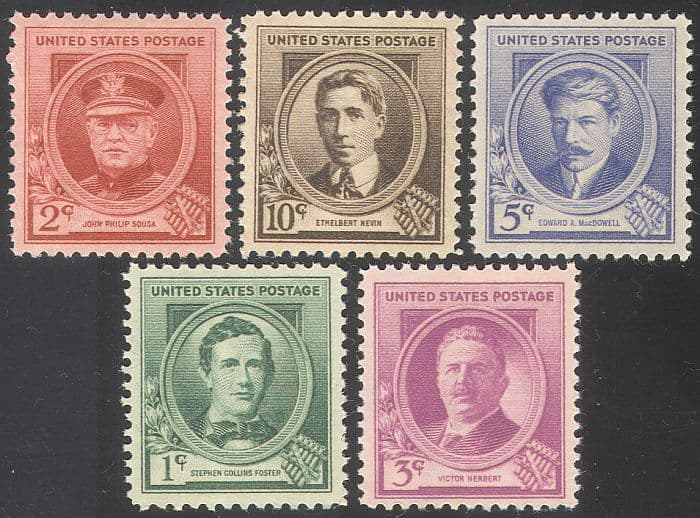
3. The cultural significance behind stamps
These five USPS stamps symbolized more than just “five musicians” at the time; they defined a cultural era.
Foster = Folk and Family Culture
Susa = Patriotism and Public Ceremonies
Herbert = The Rise of the Entertainment Industry
Mc Dowell = The Roots of Classical Music
Text = The elegant tradition of refined art songs
music.”These factors combined form a fairly complete “self-portrait of American music”.
The USPS’s approach is clear: to use stamps to preserve these musical symbols as “national memories.”
4. The contemporary impact of these musical legacies
Looking back today, you’ll find that the influence of these five individuals presents different “long tails”:
:Foster : The Eternal Symbol of American Folk Song
:Susa : It is blown every year on National Day
:Herbert : The melody is still quoted from time to time.
:Mc Dowell : “Wild Rose” remains a must-play for piano.
Text: Performed infrequently but still highly regarded in music history
In other words, the USPS stamp does not record fleeting trends but rather things that have truly become part of the core of the culture.
5. FAQ
Q: Why did the USPS issue these composer stamps in 1940?
A: To establish a classic system of American culture through USPS stamps and to provide cultural identity during turbulent times.
Q: Why are these five composers important?
A: They represent the American tradition of folk songs, marches, operettas, classical music, and art songs.
Q: Do these stamps still have collectible value?
A: They belong to the classic commemorative stamp series, have commemorative and educational significance, and the collectible market remains stable.
Conclusion: A set of USPS stamps that carry American musical memories
The “Famous American” composers series from 1940 is more than just a collection of classic USPS stamps favored by collectors; it’s more like an “official archive” of American music history.
From Foster to Sousa to Mc Dowell, their melodies, like these stamps, have become part of American culture.
If you’re looking for more USPS stamp collectibles related to American history, art, and music, check out our curated categories for collectors.
Want to explore more USPS stamps, commemorative stamps, and collectible themes?
Browse more USPS Stamp collections and new arrivals >>
Sources and update note
Use the linked primary record for the exact issue, rule or current condition. Prices, availability and platform features can change and should be checked at the time of use.