
USPS issued the Katharine Graham stamp on June 14, 2022, as the 17th entry in the Distinguished Americans series. It is a Two-Ounce rate stamp, not an ordinary one-ounce Forever Stamp. The issue honors the longtime publisher of The Washington Post and uses a portrait by artist Lynn Staley under the art direction of Derry Noyes.
Official issue details: a Two Ounce stamp
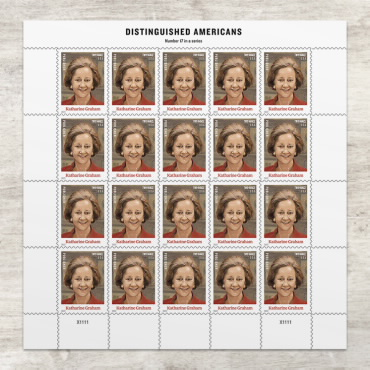
Issued in Washington, DC, on June 14, 2022, this non-denominated Distinguished Americans stamp has one design and was sold in panes of 20 (USPS item 122200). “TWO OUNCE” identifies its postal purpose; the absence of a printed cent value does not turn it into a regular one-ounce Forever stamp. These issue details distinguish the original USPS pane from a reseller’s assortment or a collector’s single.
Portrait source and design credits
USPS describes Staley’s artwork as an oil portrait based on a photograph of Graham taken in the 1970s. Its issue information does not identify that photograph’s photographer, so a photographer’s name or a 1997 photo date should not be inferred. Derry Noyes designed and art-directed the stamp. “PUBLISHER” appears at the left, “TWO OUNCE” and “USA” at the upper right, and Graham’s name below the portrait.
Reading the portrait’s visual details
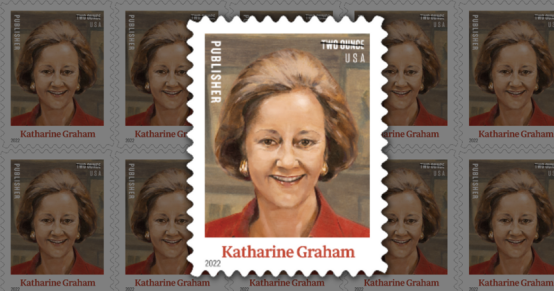
Graham is shown in a dark jacket, with short hair and her face turned slightly toward the viewer. The restrained background keeps attention on the face, while “PUBLISHER” identifies the role USPS chose to emphasize. Reading the expression as calm or resolute is visual interpretation, not a documented fact about her character.
What the visual language suggests
The 1970s source photograph places the portrait near the period when Graham led The Washington Post through the Pentagon Papers publication and Watergate reporting. The stamp itself does not depict those events; its visible elements are Graham’s portrait, her name, the “PUBLISHER” label and the TWO OUNCE service inscription. A reader may connect the portrait with that publishing history, but the connection is historical interpretation rather than a claim that the artwork proves her private thoughts or character.
Katharine Graham’s publishing career
Entering journalism
Katharine Meyer was born in 1917 and spent her childhood in Washington. She graduated from the University of Chicago in 1938, worked at a San Francisco newspaper and then joined The Washington Post. Her father, Eugene Meyer, had purchased the newspaper in 1933. She married Philip Graham in 1940; her subsequent work at the company developed within that family-owned publishing business.
Leading the Washington Post Company
After Philip Graham’s death in 1963, Katharine Graham took a leadership role at The Washington Post Company. Her tenure encompassed consequential publishing decisions and the company’s development into a major national news organization. The dated decisions below are more useful evidence of her leadership than an unsupported claim about how quickly she mastered operations or how every colleague viewed her.
The Pentagon Papers and Watergate reporting
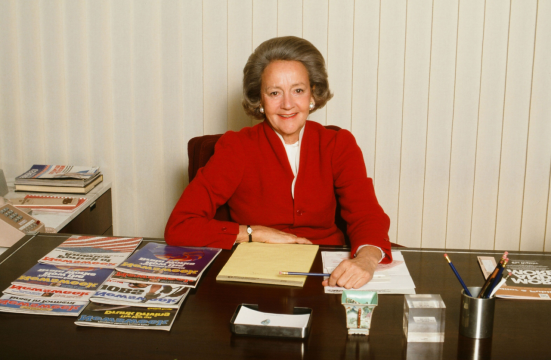
Two defining episodes during Graham’s leadership were The Washington Post’s publication of the Pentagon Papers in 1971 and its reporting on the Watergate scandal beginning in 1972. She supported the paper’s editorial work amid legal and political pressure, while reporters, editors, sources and other institutions also played distinct roles. Watergate reporting contributed to public scrutiny of the Nixon administration; it would overstate the evidence to attribute the president’s resignation solely to Graham’s personal tenacity. The USPS biographical release places these events in the context of her publishing career.
Why the stamp honors Graham
Documented milestones
The issuance of this stamp recognizes documented parts of Katharine Graham’s career. USPS identifies her as the first female head of a Fortune 500 company; Fortune also describes her as the list’s first female CEO. Her memoir Personal History was published in 1997 and won the 1998 Pulitzer Prize for Biography. She died in 2001 and was named a Presidential Medal of Freedom recipient in 2002. These dated records explain the honor more precisely than a general claim that the portrait alone proves her impact.
Broader cultural interpretation
Readers may interpret the stamp as a reminder that women can lead major institutions and defend editorial decisions in crises. That is a reading of Graham’s documented career, not a claim that USPS measured the stamp’s effect on women’s status or attributed a universal social change to one portrait. The specific historical record—the company leadership, 1971–72 publishing decisions, 1998 Pulitzer recognition and 2022 Two Ounce issue—gives that interpretation substance without turning it into an unsupported outcome claim.
Epilogue: The stamp and its lasting context
USPS dedicated the issue at the Library of Congress. That venue connects the postal honor with Graham’s publishing record without implying that the portrait itself documents private thoughts or a measurable social effect.
Current two-ounce mailing use and collector value
As checked September 27, 2026, the Katharine Graham Two Ounce stamp has $1.11 in postage value, matching the current two-ounce First-Class Mail letter rate; USPS lists its original 20-stamp pane at $22.20 before any applicable order charges. It pays exactly for a qualifying, machinable two-ounce domestic letter. On a qualifying one-ounce letter it provides more postage than the $0.82 rate requires; on a square or otherwise nonmachinable letter, a flat or a parcel, check the applicable rate and add postage if needed. Two ordinary one-ounce Forever stamps have a different combined value, $1.64 at the same rate date.
For collectors, the $1.11 mailing value and $22.20 pane face value are not appraisals. An unused single, intact pane, first-day cover or postally used example may be valued differently according to condition, format, supply and actual comparable sales. The issue date alone cannot establish a resale premium. The stamp commemorates Graham’s publishing career; its postal role and any collector-market price are separate questions.