
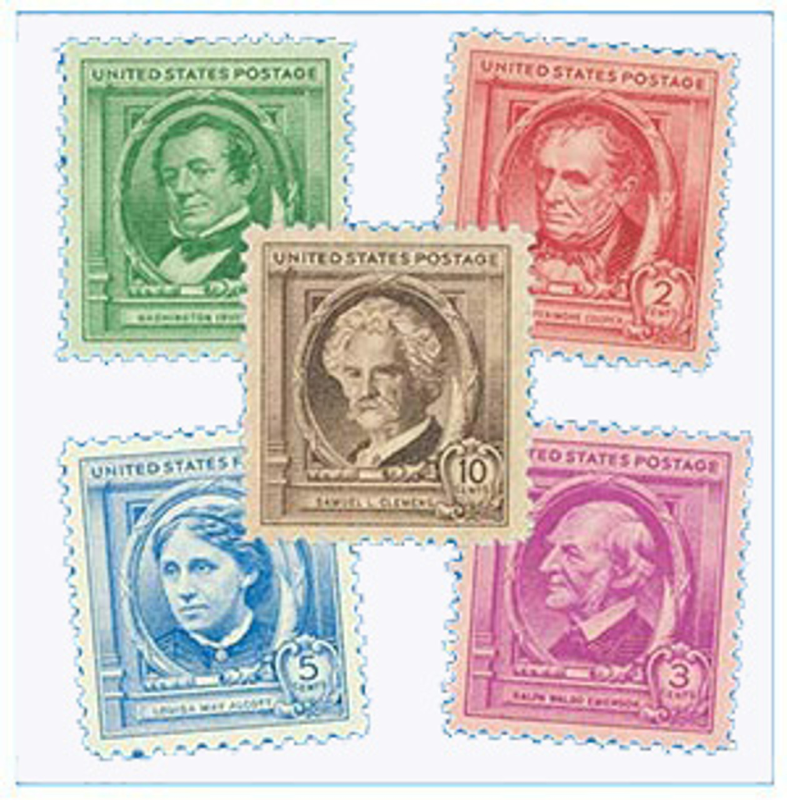
The U.S. Post Office Department—not the later USPS—issued the five Famous Americans authors stamps in 1940. The subjects are Washington Irving, Ralph Waldo Emerson, Louisa May Alcott, James Fenimore Cooper and Mark Twain; issue identity should be separated from later literary interpretation and market claims.
The five issues, in denomination order
The National Postal Museum’s Authors gallery provides an image tab and individual release details for each stamp. Its introductory prose contains some inconsistent literary dates/spellings, so the ledger below uses the individual stamp records for postal facts and standard spellings for the authors.
| Denomination/color | Portrait | Representative writing | Issue date | Visible group motif |
|---|---|---|---|---|
| 1¢ green | Washington Irving | The Legend of Sleepy Hollow; Rip Van Winkle | January 29, 1940 | Oval portrait; scroll, quill, inkwell and book at its base. |
| 2¢ red | James Fenimore Cooper | The Last of the Mohicans | January 29, 1940 | |
| 3¢ purple | Ralph Waldo Emerson | Transcendentalist essays and lectures | February 5, 1940 | |
| 5¢ blue | Louisa May Alcott | Family fiction | February 5, 1940 | |
| 10¢ brown | Samuel L. Clemens (Mark Twain) | The Adventures of Tom Sawyer; Adventures of Huckleberry Finn | February 13, 1940 |
Postal fact vs. interpretation: The issue dates, denominations, portraits and shared motifs are documented. Descriptions such as “romantic,” “rugged” or “national memory” are readings of the art and literature, not USPS design specifications or evidence that a stamp has a collectible premium.
I. Famous Americans Series: Reintegrating Cultural Figures into the National Memory
The U.S. Post Office Department issued the Famous Americans Series in 1940, decades before USPS was established. Its seven five-person groups included authors, poets, educators, scientists, composers, artists and inventors.
Within the 1940 series, the shared portrait frame and group symbols create visual continuity while the seven subject groups broaden the people represented. Any claim that this issue caused the entire later U.S. stamp-design tradition would require a documented design history, so the analysis here is limited to observable features of the series itself.
II. Observable design features of the Authors stamps
The five monochrome engravings share an oval portrait, scroll, quill, inkwell and book. Their fine lines and tonal variation are visible design features; the printed name, denomination and color in the ledger above identify the individual issue. None reproduces a scene from the subject’s fiction or encodes a documented philosophical trait in the face, so compare the actual museum images instead of treating a literary interpretation as a stamp specification.
III. Five authors represented in the 1940 group
1. Washington Irving
Irving’s The Legend of Sleepy Hollow and Rip Van Winkle give two narrative works to pair with his portrait. The stamp itself does not illustrate either tale: identify this physical issue by its printed Irving name and the Authors group’s shared scroll, quill, inkwell and book rather than by a guessed scene or mood. Its green 1¢ denomination and January 29, 1940 date are recorded in the ledger above.
2. Ralph Waldo Emerson
Ralph Waldo Emerson’s essays and lectures are associated with Transcendentalism. The purple 3¢ stamp identifies him by name and portrait within the same visual template as the other four authors; its engraving does not itself depict nature, an essay or a philosophical proposition.
3. Louisa May Alcott
Louisa May Alcott is represented in the 1940 authors group. Her inclusion can be discussed from the surviving issue record, while broader claims about official motives or her relative rarity among women subjects require a defined source. The issuing body was the Post Office Department.
4. James Fenimore Cooper
James Fenimore Cooper is associated with frontier fiction including The Last of the Mohicans. His red 2¢ stamp shows his portrait and the shared Authors symbols, not a forest or frontier scene. The literary context helps explain the subject’s place in a writers group; the visible issue details identify the physical stamp.
5. Mark Twain
Mark Twain, the pen name of Samuel Clemens, brought vernacular speech, satire and social observation into works including The Adventures of Tom Sawyer and Adventures of Huckleberry Finn. His 10-cent position completes the five-denomination Writers group.
IV. Collecting formats and value evidence
The five related engravings form a manageable literary collection that can be arranged by denomination or postal use. A single, complete set, pane, first-day cover and mint never-hinged example are different formats: identify the exact issue and condition before comparing them. Neither an author’s fame nor the coordinated design proves rarity, demand or appreciation. A market range requires dated completed sales of genuinely comparable examples.
V. How to start your author stamp collection?
Start with the five writers in this 1940 group, or explicitly broaden the theme to other American writers; do not confuse a personal theme with the official Authors subgroup.
Use a current edition of the Scott Standard Postage Stamp Catalogue or an authoritative museum issue record to check the catalog number and exact variety; a catalog listing identifies an issue but does not authenticate a physical stamp.
Record paper, printing characteristics, perforations, gum, hinges, creases and fading for each copy. For a costly or unusual variety, compare catalog details with the physical item and seek qualified expertizing. Exhibitions and philatelic associations can help a new collector learn how to distinguish these details.
Frequently Asked Questions
Are other writers part of this Authors group?
No. The 1940 group contains Irving, Emerson, Alcott, Cooper and Twain; Longfellow and Lowell belong to the separate Poets group. A personal literature collection can include both, but should label their official groups accurately.
How should an unusual or valuable copy be checked?
Use museum images and a recognized catalog to identify the issue, then assess paper, gum, perforations, cancellation, faults and provenance. Seek qualified expertizing when warranted and use dated completed sales of comparable copies for a market claim; no numeric range is established here.
What the five portraits can and cannot tell us
Together, the five stamps document a 1940 postal selection of writers with distinct forms of fiction, essays and satire. They invite comparison with the named works above but are not a complete map of American literature or evidence of future collector demand.