
Roy Wilkins died on September 8, 1981, after decades of civil-rights leadership. On January 24, 2001, USPS issued a 34-cent Roy Wilkins commemorative stamp in its Black Heritage series. The stamp is a concrete starting point for examining how USPS remembered his journalism, NAACP leadership and civil-rights advocacy. It was a fixed-denomination 34¢ issue, not a modern ordinary Forever stamp.
What Did USPS Issue for Roy Wilkins in 2001?
USPS’s 2001 issue schedule identifies the Wilkins stamp as a 34¢ Black Heritage issue first released January 24 in Minneapolis, Minnesota, in a pressure-sensitive pane of 20. USPS’s later Black History Month publicity kit identifies his place in the series and summarizes the NAACP campaigns associated with his leadership. This issue commemorated him almost twenty years after his death; the issuance date is not an anniversary of September 8.
| Stamp fact | USPS record | What it means for a reader |
|---|---|---|
| Black Heritage series position | 24th subject; the following 2002 Langston Hughes issue was the 25th | Series sequence, not a claim that Wilkins alone achieved the movement’s legislative successes |
| First day and city | January 24, 2001; Minneapolis, MN | Separate the postal honor from Wilkins’s September 8, 1981 death |
| Original denomination and format | 34¢ fixed value; self-adhesive pane of 20 | An unused example contributes 34¢ in postage, not the current ordinary Forever value |
Inspect the actual stamp: The Smithsonian National Postal Museum’s 34¢ Roy Wilkins object record displays a documented single stamp, catalogs it as Scott USA 3501 and records the January 24, 2001 date, Black Heritage subject, lithographed adhesive format and approximately 4 × 2.5 cm dimensions. Use that object image to distinguish the issued portrait from a decorative illustration or later seller graphic. The museum labels the image rights separately; this page links to its authorized record rather than republishing the image without checking permission. The cited museum entry does not supply a designer or source-photographer credit, so those names should not be invented.
Roy Wilkins: Life, Education, and Early Life
To understand the person on the stamp, begin with the Library of Congress biographical chronology and NAACP biography. Wilkins was born in St. Louis, Missouri, in 1901 and grew up with relatives in St. Paul, Minnesota. He earned a sociology degree from the University of Minnesota in 1923. His work as a student and Black-press journalist helped prepare him for national advocacy.
While attending the university, Wilkins worked at the Minnesota Daily and the St. Paul Appeal, according to the NAACP. After graduation he edited the Kansas City Call, a Black weekly. The record supports his journalism and editorial work; it does not require an unsupported claim that he personally edited the university’s student newspaper. His reporting on Jim Crow discrimination connected local stories to the broader struggle for equal rights.
Roy Wilkins: From Journalist to Civil Rights Leader
In 1931, Walter White recruited Wilkins as NAACP assistant secretary, according to the Library of Congress NAACP exhibition. In 1934 Wilkins succeeded W. E. B. Du Bois as editor of The Crisis, the organization’s magazine. These were distinct roles at different dates; he did not begin as Du Bois’s assistant. The NAACP and Library of Congress records document his shift from local journalism to a national civil-rights organization.
He became NAACP executive secretary in 1955 and later carried the title executive director, remaining its top leader until 1977. His approach emphasized nonviolent protest, coalition-building, legislative advocacy and legal reform; it differed from some more militant strategies of the late 1960s. Calling him simply “radical” or “not radical” obscures those specific choices. The NAACP account provides the organizational chronology and describes his approach.
Roy Wilkins’ influence and obstacles
USPS’s Black Heritage background says the NAACP under Wilkins campaigned for the Civil Rights Act of 1964, the Voting Rights Act of 1965 and the Fair Housing Act of 1968. The Library of Congress documents Wilkins speaking about pending legislation at the August 28, 1963 March on Washington. These are concrete actions and organizational campaigns, not a claim that Wilkins personally wrote or enacted federal statutes.
His work faced racism outside the movement and strategic disagreement within it. The NAACP biography notes that he opposed militancy associated with the Black Power movement and continued to pursue change through nonviolent advocacy and legislation. This helps explain both his influence and the criticism he received without turning a complex debate into an unsupported personality label.
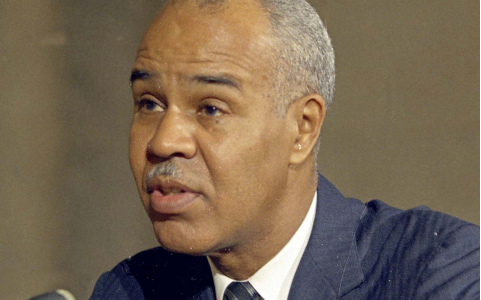
The death of a hero and his voice on stamps
Wilkins used public speaking, coalition work and his NAACP leadership to support civil-rights legislation. The Library of Congress records a March on Washington address; USPS records the NAACP’s campaigns for the 1964, 1965 and 1968 laws. Keeping those roles separate recognizes collective work and avoids saying he personally made the laws.
Wilkins died on September 8, 1981, in New York, according to the Library of Congress chronology. USPS issued the stamp on January 24, 2001. That nearly twenty-year interval matters: this was a retrospective Black Heritage honor, not a stamp released at the time of his death. For collectors and mailers, its 34¢ printed denomination is another historical marker. If an example is genuine and unused, it contributes 34¢ toward postage; at the current 82¢ one-ounce letter rate, another 48¢ would be needed for that qualifying domestic letter.
The stamp invites readers to connect a named person with a documented movement. Its series placement and fixed denomination can be checked in USPS records, while the NAACP and Library of Congress records explain the journalism, organization-building and public advocacy behind the portrait.
References for the Stamp and Biography
- USPS Postal Bulletin: 2001 issue schedule — denomination, first-day city/date and pane format.
- USPS Black History Month kit — Wilkins’s Black Heritage context and NAACP civil-rights campaigns.
- NAACP: Roy Wilkins biography — youth, journalism, leadership and strategy.
- Library of Congress: Roy Wilkins Papers — dated life chronology and collection scope.
- Library of Congress: March on Washington address — documented 1963 public advocacy.