
Identify the five stamps by visible design and issue data
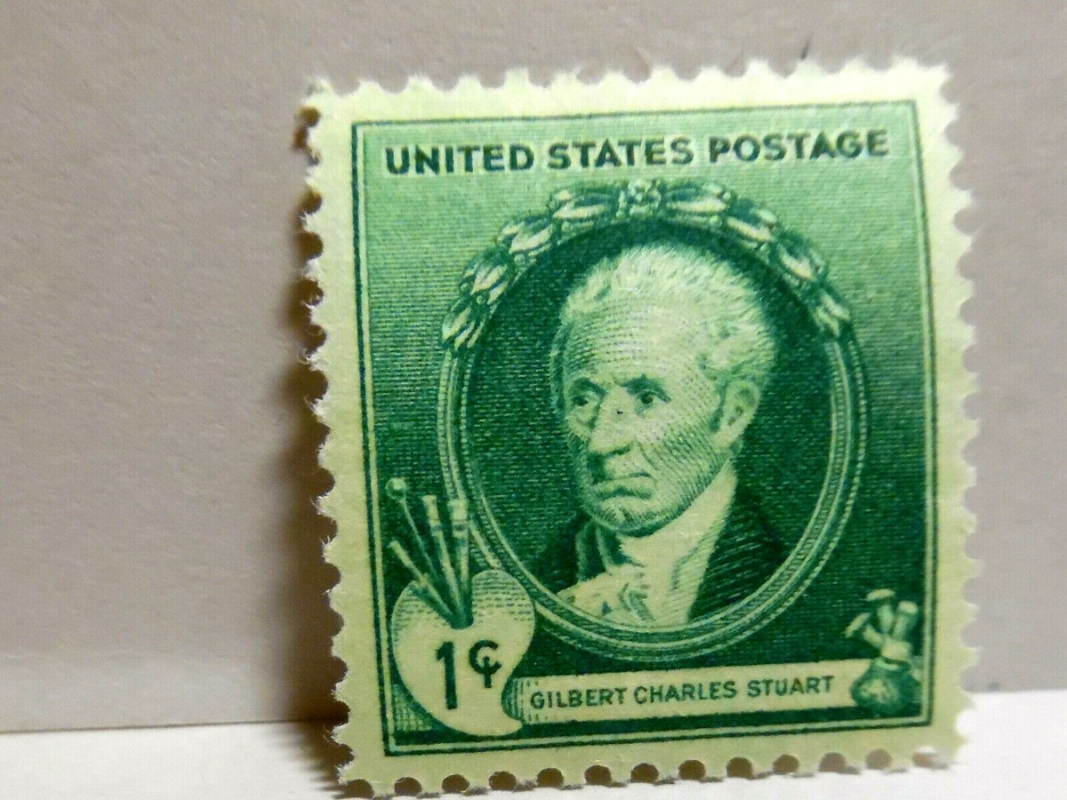
The National Postal Museum Artists gallery displays all five official images. In each, the face portrait is accompanied by the same artist’s palette and brushes, with the denomination superimposed on the palette; there is no documented separate chisel, hammer or frontier border for individual subjects. The Post Office Department’s broad colors were green, red, purple, blue and brown, while collector catalogs use more specific shade names. Compare issue fields and actual images before assigning symbolic meaning or market value.
| Subject / Scott | Artistic context | Issue date | Denomination and catalog shade | Visible image cue |
|---|---|---|---|---|
| Gilbert Stuart / 884 | Washington portraiture | September 5, 1940 | 1¢ bright blue green | Stuart portrait over shared palette-and-brush motif |
| James A. M. Whistler / 885 | Arrangement in Grey and Black No. 1 | September 5, 1940 | 2¢ rose carmine | Whistler portrait over the same motif |
| Augustus Saint-Gaudens / 886 | Sculpture and the 1907 Double Eagle design | September 16, 1940 | 3¢ bright red violet | Saint-Gaudens portrait; no sculptor-only tool border documented |
| Daniel Chester French / 887 | Seated Lincoln at the Lincoln Memorial | September 16, 1940 | 5¢ ultramarine | French portrait and shared motif |
| Frederic Remington / 888 | Paintings, illustrations and sculpture of the American West | September 30, 1940 | 10¢ dark brown | Remington portrait; no separate frontier motif documented |
These data identify a stamp, not its grade or resale price. A mint single, used single, first-day cover and complete set must be compared with the same kind of completed sale before a value claim is made.
The Post Office Department’s 1940 Famous Americans Series has 35 stamps across literature, education, science, music, art and other fields. Its five-stamp Artists group is the focus here; the issue record identifies its subjects and designs but does not measure how popular the group is with collectors.
The artists group within the 1940 Famous Americans Series
In 1940, the Post Office Department issued the Famous Americans Series. The program was divided into seven categories with five people in each category, totaling 35 stamps and extending the subjects beyond political leaders.
The five honorees span portraiture, atmospheric painting, sculpture, public monuments and images of the American West. Their careers explain the group’s breadth; the stamp faces themselves share one design framework.
Shared design and series name
Every portrait, including those of the two sculptors, uses the same palette-and-brush device; the subject’s name and denomination distinguish the individual stamps in the identification table. The 1940 designation is the Post Office Department’s Famous Americans Artists group, not a later “American Celebrity collection.” A subject’s birth or death year should not be assumed to appear on the stamp face.
Five artists and their corresponding stamps (Scott #884–#888)
1. Gilbert Stuart – 1 cent (#884)
Gilbert Stuart is known for his Washington portraits. The image on the current U.S. $1 note derives from his Athenaeum Portrait of Washington; the banknote uses an engraved adaptation rather than the original painting itself. The U.S. Currency Education Program identifies the portrait source.
The 1-cent stamp uses the shared portrait-and-palette layout in bright blue green. Its lower denomination does not prove it was printed in the greatest number or is always the cheapest in every condition; check a specific copy’s grade and comparable sales.
2. James Abbott McNeill Whistler – 2 cents (#885)
Whistler was renowned in both Europe and America. His work emphasized atmosphere, tonal harmony, color and spatial relationships; Arrangement in Grey and Black No. 1, popularly known as “Whistler’s Mother,” became his most familiar image.
The 2-cent stamp shows Whistler in the shared portrait-and-palette composition. Compare its printed name, rose-carmine color and design with the museum image; the stamp does not depict Whistler’s Mother, and no collector-preference ranking is established here.
3. Augustus Saint-Gaudens – 3 cents (#886)
Augustus Saint-Gaudens was one of America’s leading sculptors. His design for the 1907 Double Eagle coin is also celebrated in American numismatic history.
The stamp honors Saint-Gaudens as an artist, using the group’s common palette-and-brush device rather than a depiction of his 1907 coin or special sculptor’s tools. His numismatic importance may interest a cross-theme collector, but no demand or price premium is demonstrated here.
For a verified visual comparison of all five Artists stamps, use the museum’s individual image tabs. An image of the separate Poets group would not illustrate this Artists issue.
4. Daniel Chester French – 5 cents (#887)
French sculpted the seated Abraham Lincoln for the Lincoln Memorial in Washington, D.C. The 1940 stamp honors French through his portrait rather than reproducing that monument.
5. Frederic Remington – 10 cents (#888)
Remington depicted the American West through paintings, illustrations and sculpture, creating influential visual narratives of soldiers, riders and frontier life.
The 10-cent Remington stamp completes the five-subject Artists group. Denomination and cultural importance alone do not predict scarcity, market value, or future appreciation.
Condition and comparable-sale checks
Identify the exact Scott number and format—a single, complete five-denomination set or first-day cover—then record centering, full perforation edges, faults, cancellations and original gum where applicable. For a first-day cover, verify the issue date and city for that specific stamp; the group was not issued all at once. Without issue-specific quantities and dated completed sales of the same format and condition, no scarcity ranking, individual price range or set premium follows from an artist’s fame or stamp denomination.
Frequently Asked Questions (FAQ)
Why is Remington on the highest denomination?
The National Postal Museum’s Famous Americans explanation says the seven groups of five were issued in honorees’ birth order. In this Artists group, Stuart (1755) precedes Whistler (1834), Saint-Gaudens (1848), French (1850) and Remington (1861), so the youngest appears on 10¢. This documented ordering rule is not a claim that Remington was considered more important or that his stamp is more valuable.
How do I assess authenticity?
First identify the correct catalog listing and compare the actual design, denomination, paper, perforations, cancellation and gum with authoritative reference material. A Scott number is a catalog identifier, not a security mark or proof that the physical stamp is genuine. If an unusual variety, high price or suspected alteration matters, seek qualified expertizing or a recognized certificate before making a market claim.
Conclusion: A collection of USPS stamps that encapsulate American art history
The five 1940 Post Office Department portraits connect Stuart’s Washington portraiture, Whistler’s painting, Saint-Gaudens’s sculpture and coin design, French’s Lincoln Memorial figure and Remington’s Western art. Compare the actual palette-and-brush stamp images with the identification table, then use condition and dated like-for-like sales—not fame or denomination—when discussing collectible value.
Sources and update note
Use the linked primary record for the exact issue, rule or current condition. Prices, availability and platform features can change and should be checked at the time of use.