
September 8, 2025 may seem like just an ordinary day to most people. However, in the annals of the civil rights movement, this date carries a profound weight. Forty-four years ago today, Roy Wilkins, a giant of the American civil rights movement, quietly passed away at the age of 80. His passing marked the end of an era dedicated to the struggle for equality through legal and nonviolent means. However, the hero’s story did not end there. Exactly twenty years later, when the clock of history turned back to 2001, the United States Postal Service (USPS) used a small stamp to allow his voice to resonate once again, forever capturing his legacy.
Roy Wilkins stamp facts
USPS honored Roy Wilkins in 2001 with a 34-cent Black Heritage stamp. The postal record—series identity, denomination, issue date, format and design—should lead the page; biographical context then explains the person represented without turning an anniversary narrative into evidence about the stamp.
Verified facts for this topic
Official USPS records verify these issue points: Jan Matzeliger (September 15, 1991), Ethel Waters (September 1, 1994), Count Basie (September 11, 1996), Josh White (June 26, 1998), Roy Wilkins (2001), Barbara Jordan (September 16, 2011) and Allen Toussaint (January 30, 2025).
Roy Wilkins: Life, Education, and Early Life
To understand the greatness of Roy Wilkins, one must go back to his beginnings. Born in 1901, Wilkins spent his childhood and adolescence in St. Paul, Minnesota. This had a profound impact on his life. He received a prestigious Roy Wilkins education and graduated with honors from the University of Minnesota, majoring in sociology and journalism. It was this experience that laid a solid foundation for his later career.
During his college years, he edited the student newspaper and actively participated in the movement against racial discrimination on campus. After graduation, he became a reporter for an African American newspaper, using his pen to expose social injustice. Roy Wilkins’ early life was filled with keen observations of social issues and a passionate pursuit of equality. This experience taught him that journalism and advocacy are powerful tools for social change.
Roy Wilkins: From Journalist to Civil Rights Leader
In 1931, Wilkins took a pivotal step in his life when he joined the National Association for the Advancement of Colored People (NAACP) This marked a pivotal moment in Roy Wilkins’s life transitioning from a journalist to a full-time civil rights activist. Initially, he served as assistant secretary for the organization, working alongside W. E. B. Du Bois, one of the NAACP’s founders. Within the NAACP, he focused on what Roy Wilkins did : he spearheaded the anti-lynching movement and bolstered support for anti-racism laws.
In 1955, he took over as executive director of the NAACP, beginning his 22-year tenure as the organization’s top leader. Contrary to the perception of some that he was a radical the question of why Roy Wilkins became a radical is inaccurate. Wilkins adhered to the strategy of nonviolence and legal struggle. He believed that only through the American judicial and legislative systems could racial issues be fundamentally resolved. His pragmatic approach complemented the mass activism of Martin Luther King Jr. and others, jointly advancing the civil rights movement.
Roy Wilkins’ influence and obstacles
Under Wilkins’ leadership, the NAACP achieved many landmark victories. He pushed for the passage of the Civil Rights Act of 1964 and the Voting Rights Act of 1965, laws that permanently changed the legal foundation of American society and had a profound impact on the lives of African Americans
However, his path was not without its challenges. Throughout his career, he faced formidable obstacles, including Roy Wilkins He not only had to contend with entrenched racism but also with divisions within the civil rights movement. In the 1960s, with the rise of the Black Power movement, many young people resented Wilkins’s progressive approach, viewing him as overly conservative. Yet, he remained steadfast in his convictions, unwavering even in the face of criticism and internal pressure.
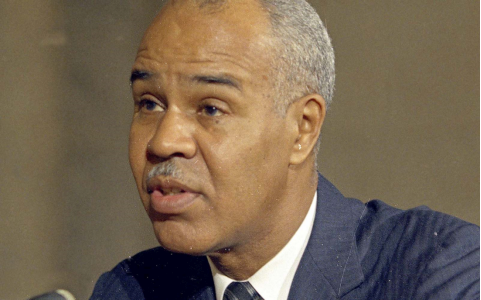
The death of a hero and his voice on stamps
Roy Wilkins died peacefully on September 8, 1981, leaving behind countless laws he had personally created and the equality he fought for. His passing led many to believe that an era had ended.
However, the historical narrative does not end there. On January 24, 2001, the United States Postal Service (USPS) issued a 34-cent stamp, capturing his portrait on a single inch. This USPS stamp is not only a tribute to him personally, but also a reaffirmation of the spirit of the entire civil rights movement. It reminds us that Roy Wilkins’ story, and the ideals of peace and justice he represented, will be forever remembered.
“From his birth to his death and to the creation of this stamp, Roy Wilkins’ life is an indelible chapter in American history. Today, we commemorate him not only because he was a great leader, but also because his spirit, through this stamp, has become part of our shared history.”
References
NAACP. Roy Wilkins (1901–1981)
United States Postal Service (USPS). Black Heritage Stamp Series
Wikipedia. Roy Wilkins
US National Archives. Civil Rights Act of 1964 & Voting Rights Act of 1965
Sources and update note
Use the linked primary record for the exact issue, rule or current condition. Prices, availability and platform features can change and should be checked at the time of use.